Skip to main content
_202505051649450844.png)
_202505051650275145.png)
_202505051651195147.png)
_202505051652008448.png)
_202505051653069499.png)
_202505051653427100.png)


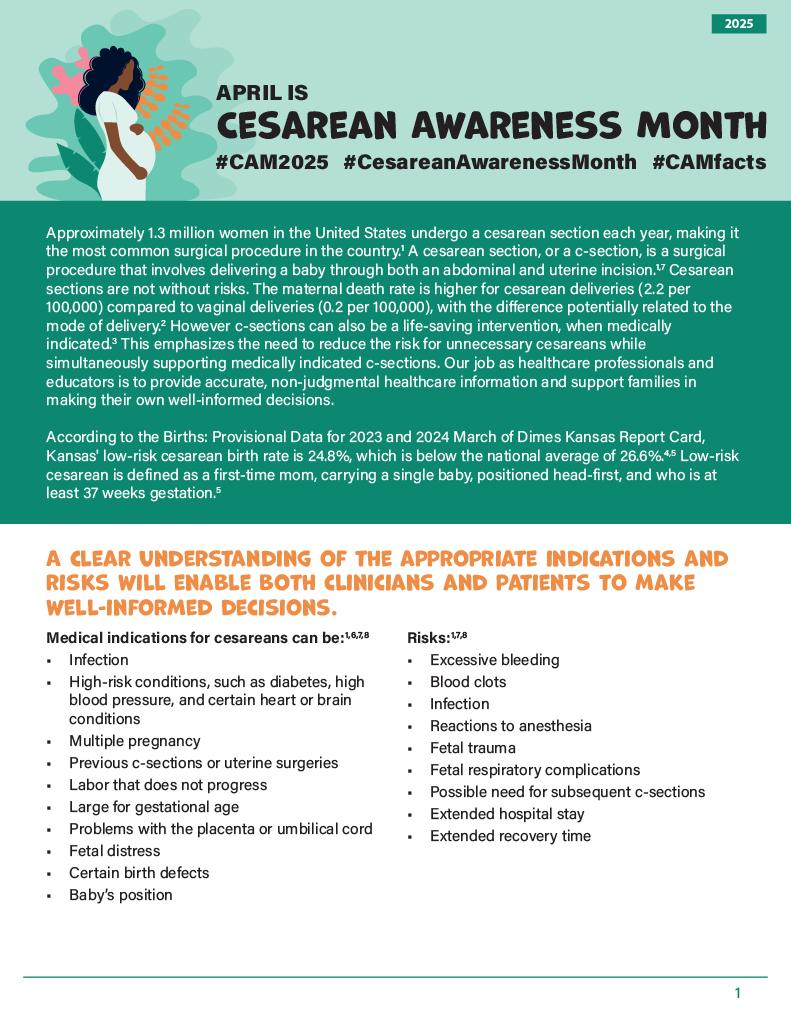
Approximately 1.3 million women in the United States undergo a cesarean section each year, making it the most common surgical procedure in the country.1 A cesarean section, or a c-section, is a surgical procedure that involves delivering a baby through both an abdominal and uterine incision.1,7 Cesarean sections are not without risks. The maternal death rate is higher for cesarean deliveries (2.2 per 100,000) compared to vaginal deliveries (0.2 per 100,000), with the difference potentially related to the mode of delivery.2 However c-sections can also be a life-saving intervention, when medically indicated.3 This emphasizes the need to reduce the risk for unnecessary cesareans while simultaneously supporting medically indicated c-sections. Our job as healthcare professionals and educators is to provide accurate, non-judgmental healthcare information and support families in making their own well-informed decisions.
According to the Births: Provisional Data for 2023 and 2024 March of Dimes Kansas Report Card, Kansas' low-risk cesarean birth rate is 24.8%, which is below the national average of 26.6%.4,5 Low-risk cesarean is defined as a first-time mom, carrying a single baby, positioned head-first, and who is at least 37 weeks gestation.5
Social Media Graphics and Messages
Post 1
English: April is Cesarean Awareness Month. Know the warning signs of post-cesarean birth complications: fever; red, swollen, painful wound; difficulties using the bathroom (urinating); pain that is uncontrollable; discharge from your incision site; blood clots that are larger than a golf ball size; chest pain; shortness of breath; dizziness; headache that does not go away with pain medicine. If you experience any of these symptoms, call your healthcare provider or 9-1-1.
americanpregnancy.org/healthy-pregnancy/labor-and-birth/cesarean-aftercare
Spanish: Abril es el mes de la concienciación sobre la cesárea. Conozca los síntomas de advertencia de las complicaciones del parto después de una cesárea: Fiebre; rojo, hinchado, herida dolorosa; dificultades para ir al baño (orinar); dolor que es incontrolable; secreción de la incisión; coágulos de sangre que son más grandes que el tamaño de una pelota de golf; dolor torácico; dificultad para respirar; mareos; dolor de cabeza que no desaparece con analgésicos. Si experimenta alguno de estos síntomas, llame a su médico o al 9-1-1.
americanpregnancy.org/healthy-pregnancy/labor-and-birth/cesarean-aftercare
Post 2
English: Cesarean may not have been what you prepared for, and it can be a challenging process to fully recover. You should never feel as though you're alone! C-sections, particularly under urgent or emergent circumstances, can be very traumatic. Share your thoughts with your support system, participate in free online birth trauma groups or find a perinatal mental health certified professional who is trained specifically in pregnancy and postpartum care.
postpartum.net/get-help/psi-online-support-meetings
Spanish: Puede que la cesárea no fue lo que usted había previsto y puede ser un proceso complicado de recuperación total. ¡Nunca debe sentirse sola! Las cesáreas, sobre todo en circunstancias urgentes o de emergencia, pueden ser muy traumáticas. Comparta sus inquietudes con su sistema de apoyo, participe en grupos gratuitos en línea sobre traumas del parto o busque un profesional certificado en salud mental perinatal con formación específica en atención durante el embarazo y el posparto.
postpartum.net/en-espanol
Post 3
English: April is Cesarean Awareness Month. Getting out of bed and moving around is crucial for your recovery. Here are some tips to getting up and around safely: Gently roll to your side while keeping your knees bent. Using your arms, carefully (and slowly!) push your body into a sitting position while keeping your abdomen relaxed, or even better, holding a pillow against your incision. Once you are sitting upright, take a moment, and then stand. Learn more c-section recovery tips:
mayoclinic.org/healthy-lifestyle/labor-and-delivery/in-depth/c-section-recovery/art-20047310
Spanish: Abril es el mes de la concienciación sobre la cesárea. Levantarse de la cama y moverse es fundamental para la recuperación. Aquí tiene algunos consejos para levantarse y moverse con cuidado: gire suavemente hacia un lado manteniendo las rodillas flexionadas. Utilizando sus brazos, empuje con cuidado (¡y lentamente!) su cuerpo hasta llegar a una posición en que se pueda sentar mientras mantiene su abdomen relajado o incluso mejor, sosteniendo una almohada contra su incisión. Una vez que esté sentada en posición vertical, dese un momento y después póngase de pie. Aprenda más consejos para la recuperación de la cesárea en:
mayoclinic.org/healthy-lifestyle/labor-and-delivery/in-depth/c-section-recovery/art-20047310
Post 4
English: April is Cesarean Awareness Month. While the U.S. does not have a universal paid family leave policy, there are protections for pregnant and postpartum workers. Reasonable accommodations are available for every pregnant and postpartum worker. Learn about your rights as a pregnant and postpartum mom:
eeoc.gov/statutes/pregnant-workers-fairness-act
Spanish: Abril es el mes de la concienciación sobre la cesárea. Aunque EE.UU. no tiene una política universal de baja familiar retribuida, existen protecciones para las trabajadoras embarazadas y en puerperio. Se ofrecen adaptaciones razonables para todas las trabajadoras embarazadas y en puerperio. Aprenda cuáles son sus derechos como madre embarazada y en puerperio:
eeoc.gov/statutes/pregnant-workers-fairness-act
Post 5
English: April is Cesarean Awareness Month. Breastfeeding after cesarean may look different than you anticipated. Some breastfeeding positions will be more comfortable than others after a c-section birth. Learn more:
healthychildren.org/English/ages-stages/baby/breastfeeding/Pages/Breastfeeding-After-Cesarean-Delivery.aspx
Spanish: Abril es el mes de la concienciación sobre la cesárea. La lactancia después de una cesárea puede ser diferente de lo que usted esperaba. Algunas posiciones de lactancia serán más cómodas que otras después de un parto por cesárea. Aprenda más en:
healthychildren.org/spanish/ages-stages/baby/breastfeeding/paginas/breastfeeding-after-cesarean-delivery.aspx
Post 6
English: April is Cesarean Awareness Month. Cesareans are most commonly used as life‑saving procedures, however, non‑medical cesareans can put pregnant people and babies at a higher risk for complications. Take the time to talk through your options with your midwife or medical provider to have a plan in place for birth. Learn more:
marchofdimes.org/find-support/topics/birth/medical-reasons-c-section
Spanish: Abril es el mes de la concienciación sobre la cesárea. Las cesáreas son procedimientos utilizados comúnmente para salvar vidas, sin embargo, las cesáreas no médicas pueden exponer a las embarazadas y a los bebés a un mayor riesgo de complicaciones. Consulte sus opciones con su partera o proveedor médico, para establecer un plan para el parto. Aprenda más en:
marchofdimes.org/find-support/topics/birth/medical-reasons-c-section
Resources for Health Care Professionals
- ACOG Cesarean Delivery on Maternal Request
- ACOG Vaginal Birth After Cesarean Delivery
- ACOG Counseling Regarding Approach to Delivery After Cesarean and Use of Vaginal Birth After Cesarean Calculator
- March of Dimes - Kansas Report Card 2024
- National Accreta Foundation - Cearean Awareness Month Toolkit
- DONA - 5 Reasons to Have a Doula During Your Cesarean Birth
Resources for Pregnant People
- ACOG Expert View "I'm an Ob-Gyn and I had 2 Cesarean Births. I'm Not a Failure."
- American Pregnancy Association - Cesarean Information
- Birth Trauma Support for Black, Indigenous, People of Color (BIPOC) PSI Online Support Group
- Birth Trauma Support - PSI Online Support Group
- March of Dimes - Cesarean Information
Reference:
1. Sung, S., Mikes, B. A., Martingano, D. J., & Mahdy, H. (2024). Cesarean Delivery. StatPearls Publishing.
2. Clark, S. L., Belfort, M. A., Dildy, G. A., Herbst, M. A., Meyers, J. A., & Hankins, G. D. (2008). Maternal death in the 21st century: causes, prevention, and relationship to cesarean delivery. American Journal of Obstetrics & Gynecology, 199(36), e1–36.e5.
3. Sandall, J., Tribe, R. M., Avery, L., Mola, G., Visser, G. H., Homer, C. S., Gibbons, D., Kelly, N. M., Kennedy, H. P., Kidanto, H., Taylor, P., & Temmerman, M. (2018). Short-term and long-term effects of caesarean section on the health of women and children. Lancet (London, England), 392(10155), 1349–1357.
4. Hamilton BE, Martin JA, Osterman MJK. Births: provisional data for 2023. Vital Statistics Rapid Release; no 35. April 2024.
5. March of Dimes. (2024). 2024 March of Dimes Report Card Kansas. March of Dimes.
6. American College of Obstetricians and Gynecologists. (2022). Cesarean Birth.
7. Mayo Clinic. (2022, June 16). C-section. Tests & Procedures.
8. 7. March of Dimes (2024, November). Medical reasons for a c-section. Birth.